When Companies Don’t Need to Own the Capability
Porsche’s decision to sell MHP to Tata Consultancy Services raises a broader strategic question: when does a company need to own a capability, and when is reliable access enough? This insight examines capability ownership, control, dependency, switching risk and AI through a practical business architecture lens.
What the Porsche–Tata Consultancy Services deal reveals about ownership, control and strategic access
There is an interesting question sitting behind Porsche’s decision to sell MHP to Tata Consultancy Services: why would a company give up capability ownership when it still intends to rely on those capabilities?
On 24 August 2026, Porsche announced an agreement to sell its management and IT consultancy MHP to Tata Consultancy Services. At the same time, Porsche and Tata Consultancy Services announced a five-year strategic collaboration focused on artificial intelligence and digital transformation, with MHP continuing to work with Porsche after the change in ownership. Tata Consultancy Services is also establishing an AI Mobility Centre of Excellence for Porsche.
Porsche has described the transaction as part of its effort to concentrate more strongly on its core business. That explanation is straightforward, but the structure of the deal raises a broader question about how companies decide what should remain inside their ownership boundary.
MHP does not simply disappear from Porsche’s operating environment. The ownership changes, but the relationship continues. Porsche is therefore accepting a different arrangement for obtaining a capability that remains relevant to its business.
That distinction is important because companies often treat strategic importance and ownership as if they were the same decision. They are not. But separating them does not mean that ownership, control and access can be treated as completely independent either.
The real strategic question lies in the trade-off between them.
Table of Contents
- Strategic importance does not automatically require capability ownership
- Ownership, control and access are connected, not interchangeable
- What Porsche is actually changing
- The €320 million acquisition and the €1.25 billion relationship
- Why MHP may become more valuable under Tata Consultancy Services
- This is outsourcing, but the strategic decision is bigger than outsourcing
- AI makes the ownership boundary more important
- A capability is not necessarily one thing
- What this means for Porsche
- When ownership still matters
- When external ownership can make sense
- What this means for Market Delivery Architecture
- The broader lesson
- Frequently Asked Questions
Strategic importance does not automatically require capability ownership
When a capability is important, keeping it inside the organization can feel like the safest option. Ownership gives management direct authority over investment, people, priorities and development. It also gives the company a degree of flexibility that can be difficult to reproduce through a commercial contract.
There is a cost to that flexibility. The company must fund the capability, maintain the associated organization and continue investing in the skills and infrastructure needed to keep it relevant.
That cost may be entirely justified when the capability is a source of differentiation or when losing direct control would expose the business to unacceptable strategic risk.
But there are other situations in which the company may decide that it needs the capability without needing to own the organization that provides it.
That is the distinction worth examining in the Porsche transaction.
Porsche is not saying that MHP’s capabilities have stopped being useful. It is changing the organizational structure through which those capabilities are accessed.
Ownership, control and access are connected, not interchangeable
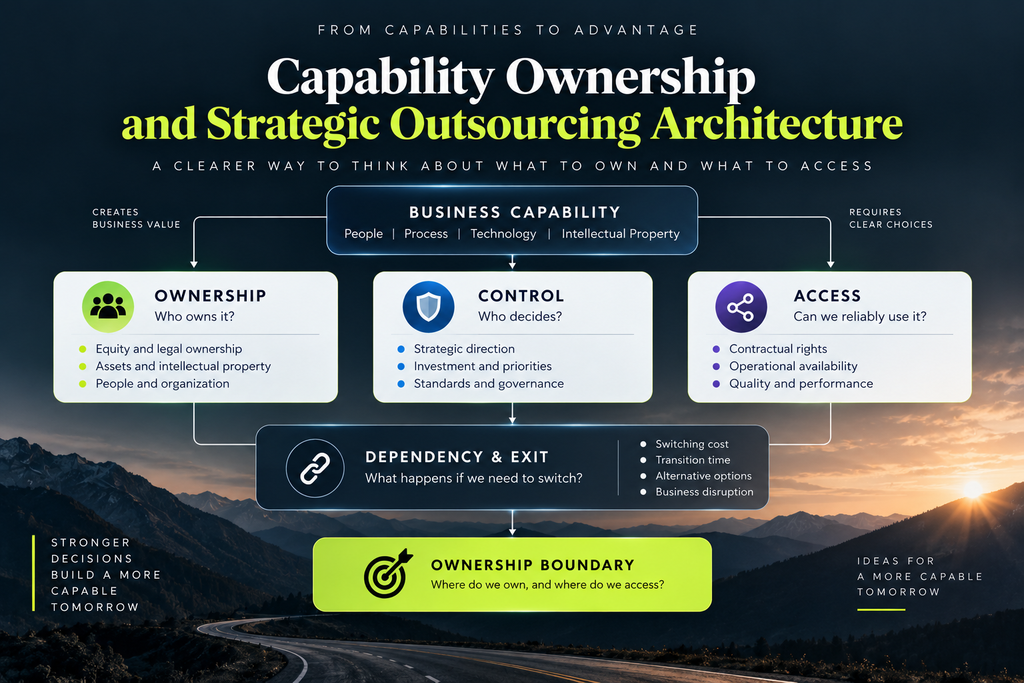
It is tempting to describe ownership, control, access and value capture as four separate levers. In practice, they are better understood as connected parts of the same decision.
Ownership gives a company the strongest foundation for direct control. When ownership moves to another organization, direct control normally decreases, although the customer may retain some influence through contracts, governance arrangements, service commitments or other mechanisms.
Those mechanisms can protect access, but they do not recreate ownership.
This matters because access is not simply a technical question of whether a service is available. It also depends on the provider’s incentives, capacity, investment decisions, contractual commitments and the customer’s ability to switch if the relationship stops working.
Control therefore affects the quality and resilience of access.
The relationship also works in the other direction. If a capability is easy to replace and several credible providers can supply it, the business may be comfortable giving up ownership. If replacing the capability would take years, require scarce expertise or disrupt a critical part of the business, giving up ownership becomes a much more consequential decision.
The four ideas are therefore useful for analysis, but they should not be treated as independent switches that management can move without affecting one another.
They describe different dimensions of the same architectural choice.
What Porsche is actually changing
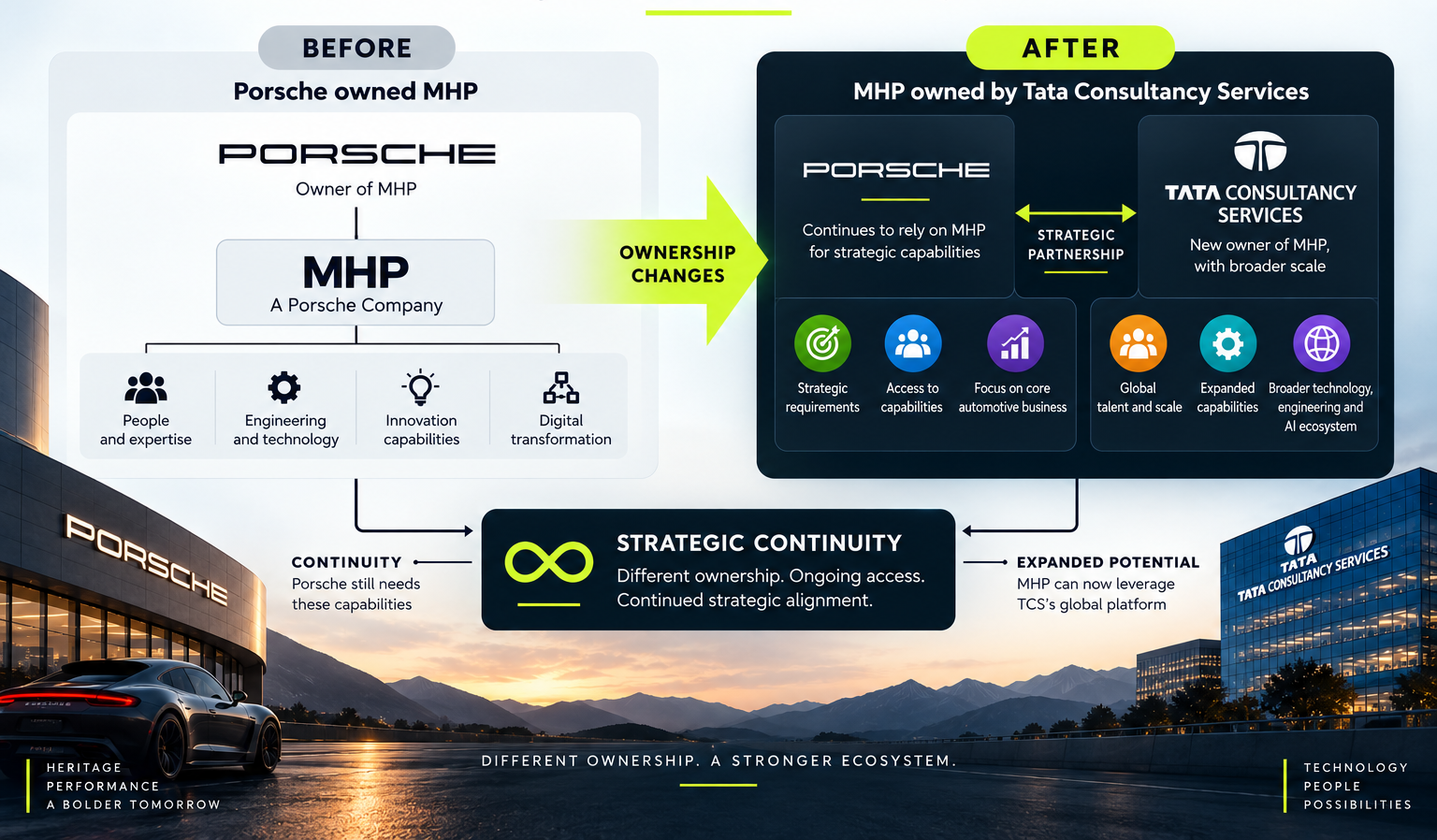
After the transaction, Tata Consultancy Services will own MHP, subject to regulatory approvals, while MHP will remain a distinct business within the Tata Consultancy Services group. Porsche and MHP are expected to continue their established relationship.
Porsche will therefore no longer have the same direct authority over MHP that it had when MHP was within its ownership structure.
That is an important part of the transaction and should not be hidden behind the idea of “continued access.”
What Porsche retains is a long-term commercial and strategic relationship. That relationship can provide meaningful access to MHP’s expertise, but it does so under a different ownership structure and with a different balance of control.
Tata Consultancy Services, meanwhile, takes on ownership of MHP and gains responsibility for developing the business. It can also combine MHP’s automotive and industrial expertise with its own global technology, engineering and artificial intelligence capabilities.
The decision therefore involves an exchange. Porsche gives up some direct control and accepts greater dependence on a strategic partner. In return, it can focus its own organizational resources more closely on its core business while accessing the capabilities of MHP and the broader Tata Consultancy Services ecosystem.
Whether that is a better arrangement depends on whether the benefits outweigh the control and dependency that Porsche is giving up.
The €320 million acquisition and the €1.25 billion relationship
The financial structure makes this trade-off particularly visible.
Tata Consultancy Services is acquiring MHP for an enterprise value of €320 million, while Porsche and Tata Consultancy Services have established a five-year strategic relationship worth €1.25 billion.
The numbers should not be interpreted as proof that Porsche is saving money. The public announcement does not provide enough information to make that conclusion.
What they do show is that Porsche is willing to maintain a substantial commercial relationship with a business that it will no longer own.
That tells us something important about the nature of the decision. The objective is not simply to eliminate spending associated with MHP. Porsche is changing the structure through which it obtains transformation capabilities while maintaining a significant relationship with Tata Consultancy Services and MHP.
The economic question is therefore more complicated than “owning is expensive and outsourcing is cheaper.”
An external provider has its own economics and margin requirements, and a long-term commercial agreement creates financial commitments of its own. Externalization can reduce certain ownership burdens while increasing other forms of contractual and supplier exposure.
Without detailed financial data, it would be inappropriate to claim that Porsche will necessarily achieve a lower long-term cost.
The more defensible conclusion is that Porsche appears to have decided that the benefits of changing the ownership structure are worth the trade-offs involved.
Why MHP may become more valuable under Tata Consultancy Services
The transaction also raises an interesting question about where a capability creates the most value.
MHP has developed specialist expertise across automotive and industrial consulting and implementation, including business transformation, artificial intelligence, SAP, manufacturing digitalisation and connected mobility. Tata Consultancy Services can combine that expertise with its own technology, engineering and AI capabilities and potentially deploy the resulting capabilities across a broader customer base.
That does not mean MHP was poorly positioned inside Porsche.
It means the economics of a specialist capability can change when its potential customer base changes.
Within Porsche, MHP’s role was closely connected to the needs of one corporate ecosystem. Within Tata Consultancy Services, the same expertise can potentially serve Porsche alongside other automotive and industrial customers.
That creates opportunities for broader utilization, investment and commercialization.
But it also introduces a different set of incentives. Tata Consultancy Services has to balance Porsche’s requirements with those of its other customers and with the commercial interests of the wider business.
For Porsche, that is part of the trade-off. It may gain access to greater external scale while accepting that MHP is no longer an organization whose priorities are ultimately determined from inside Porsche.
This is outsourcing, but the strategic decision is bigger than outsourcing
It would be reasonable to describe the resulting relationship as strategic outsourcing. Porsche is relying on an external organization for capabilities that previously existed within its ownership structure.
There is no need to avoid that description.
What makes the transaction strategically interesting is the decision that comes before the outsourcing question.
The company has effectively asked whether it needs to own the organization that provides the capability in order to achieve its strategic objectives.
That is a broader question than whether an outside supplier can perform an activity more efficiently.
A business can decide that a capability remains important while concluding that direct ownership of the organization providing it is no longer necessary. It can also reach the opposite conclusion when the capability requires a level of control, flexibility or knowledge retention that a supplier relationship cannot provide.
The distinction is therefore not between “outsourcing” and something completely different.
It is between outsourcing as an operational decision and ownership as a strategic architectural decision.
AI makes the ownership boundary more important
Artificial intelligence is central to the new Porsche–Tata Consultancy Services relationship. Tata Consultancy Services plans to establish an AI Mobility Centre of Excellence for Porsche, with the partnership covering areas including manufacturing, engineering, operations and customer experience.
It would nevertheless be too simplistic to say that AI caused Porsche to sell MHP. Porsche’s stated rationale is broader and focuses on strategic concentration around its core business.
What AI does is make the ownership decision more difficult.
Technology capabilities are evolving quickly, specialist talent is expensive and the boundaries between consulting, engineering, software and implementation are becoming less clear. Companies increasingly have to decide not only which capabilities they need, but how much of the underlying capability they should build and maintain themselves.
That does not mean the answer is to own everything that looks strategic or outsource everything that changes quickly.
It means the ownership boundary needs to be considered at the level where strategic value and dependency actually sit.
A capability is not necessarily one thing
This becomes especially important with artificial intelligence because an “AI capability” can contain several different layers.
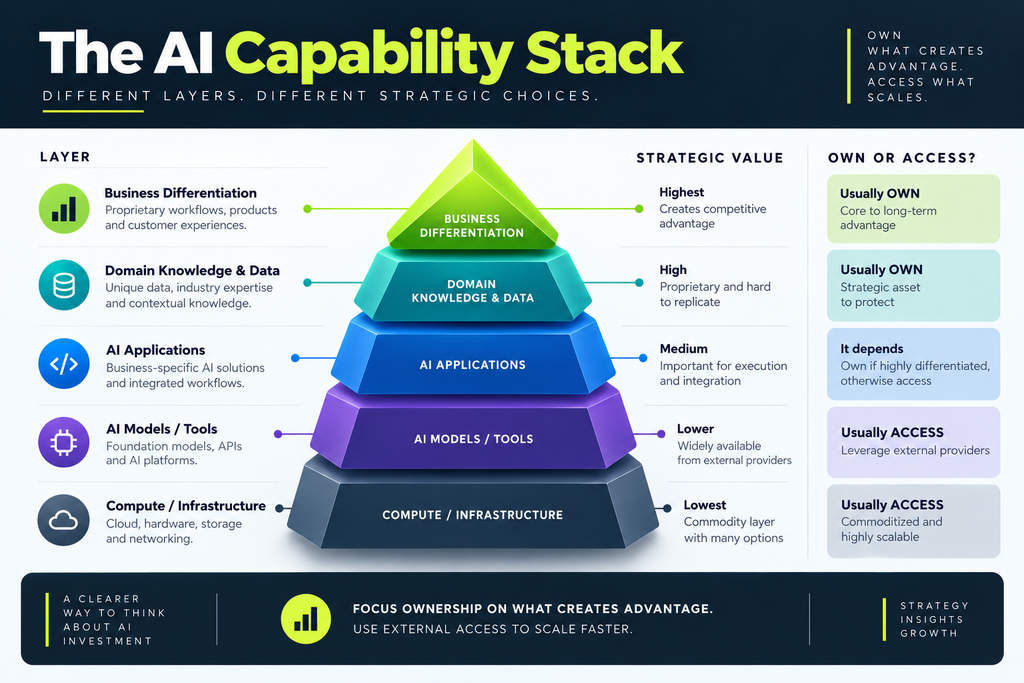
A company may depend on external computing infrastructure and third-party models while retaining proprietary data, domain knowledge, workflows and applications internally.
Those layers do not necessarily have the same strategic importance.
Own what creates differentiation
If proprietary data, domain knowledge, algorithms, workflows or AI-enabled products create a meaningful competitive advantage, the company has a stronger reason to retain ownership or substantial control over those elements.
For a company such as Porsche, that could include AI applications deeply connected to its engineering knowledge, manufacturing processes, product development or customer experience.
The strategic value may not sit in the underlying AI model itself. It may sit in the company’s unique data, domain expertise and the way AI is embedded into the business.
That distinction matters because the most expensive or technically sophisticated layer of a technology stack is not automatically the layer that creates the competitive advantage.
Externally access capabilities that are sufficiently standardized
Other parts of the AI stack may not justify direct ownership.
General-purpose infrastructure, widely available tools and some model capabilities can potentially be accessed through external providers, particularly when maintaining them internally would require constant investment without creating meaningful differentiation.
But “standardized” should never be treated as a permanent classification.
A capability that looks commoditized today can become a strategic chokepoint tomorrow if the market consolidates around a small number of providers, switching becomes difficult or control over that capability starts to influence the economics of the wider business.
The classification therefore needs to be revisited as technology and markets change.
Control the interfaces that matter
The most practical answer for many companies will be a hybrid architecture.
The company can retain control over its proprietary data, critical workflows, architecture, governance and strategic applications while using external providers for parts of the underlying technology stack.
That allows the business to benefit from external investment and specialist scale without handing over every strategically important layer.
But formal control is not enough.
If the people who understand those interfaces gradually move outside the company, the governance structure may remain while the practical knowledge needed to challenge the provider disappears. Retaining enough internal architectural talent is therefore important not only for managing the interfaces, but also for preventing dependency from gradually shifting bargaining power towards the provider.
This is particularly important in a long-term relationship.
A company can begin with strong internal knowledge and gradually lose it as implementation, maintenance and specialist expertise move further into the external provider. Over time, the provider may know more about the architecture than the customer does.
At that point, contractual control may remain on paper while practical control has weakened.
What this means for Porsche
This layered view makes the Porsche transaction easier to understand.
Porsche does not appear to be abandoning digital transformation or reducing its need for technology expertise. The new relationship with Tata Consultancy Services includes significant commitments around artificial intelligence, engineering, manufacturing, operations and customer experience.
The decision is therefore less about whether Porsche needs digital and AI capabilities.
It is about which parts of those capabilities Porsche needs to own directly.
MHP can remain an important source of expertise without remaining a Porsche subsidiary. Tata Consultancy Services can provide broader technology and engineering scale while Porsche retains its own strategic requirements, proprietary business knowledge and decision-making authority over the areas that remain inside the company.
That does not remove dependency. It changes where dependency exists and how it is governed.
Whether that architecture proves successful will depend partly on Porsche’s ability to retain control over the elements that matter most while maintaining enough flexibility to adapt if technology, commercial priorities or the relationship itself changes.
When ownership still matters
There are good reasons for a company to retain ownership even when an external provider appears capable of doing the work.
Ownership can matter when the capability contains proprietary knowledge that is difficult to protect contractually, when rapid changes in strategic direction require direct control, when the capability is deeply embedded in the company’s competitive advantage or when switching providers would be extremely difficult.
It can also matter when the capability is likely to become more important over time.
A capability that looks operational today may become strategic tomorrow. If the company has already transferred ownership, rebuilding the capability later may be expensive or impossible.
This is why ownership decisions should not be based only on the organization’s current priorities. They need to consider how the capability and the market around it might evolve.
When external ownership can make sense
External ownership becomes more attractive when the capability is specialized but not itself a source of differentiation, when a provider can invest at a scale the company would struggle to justify internally, or when the business values access to a wider technology and talent ecosystem.
The potential benefits can include specialist expertise, broader investment capacity and access to capabilities that are changing faster than an internal organization can reasonably maintain.
But those benefits should be evaluated alongside the risks.
The relevant comparison is not simply internal cost versus supplier price. It is the total strategic position created by each ownership model.
That includes control, resilience, switching options, knowledge retention, contractual exposure and the ability to change direction later.
What this means for Market Delivery Architecture
Market Delivery Architecture is concerned with how a business organizes the capabilities, ownership structures, operating responsibilities and routes through which its strategy is delivered. The underlying idea is that different parts of a business can require different structural arrangements depending on the role they play in creating and delivering value.
Capability ownership is one part of that architecture.
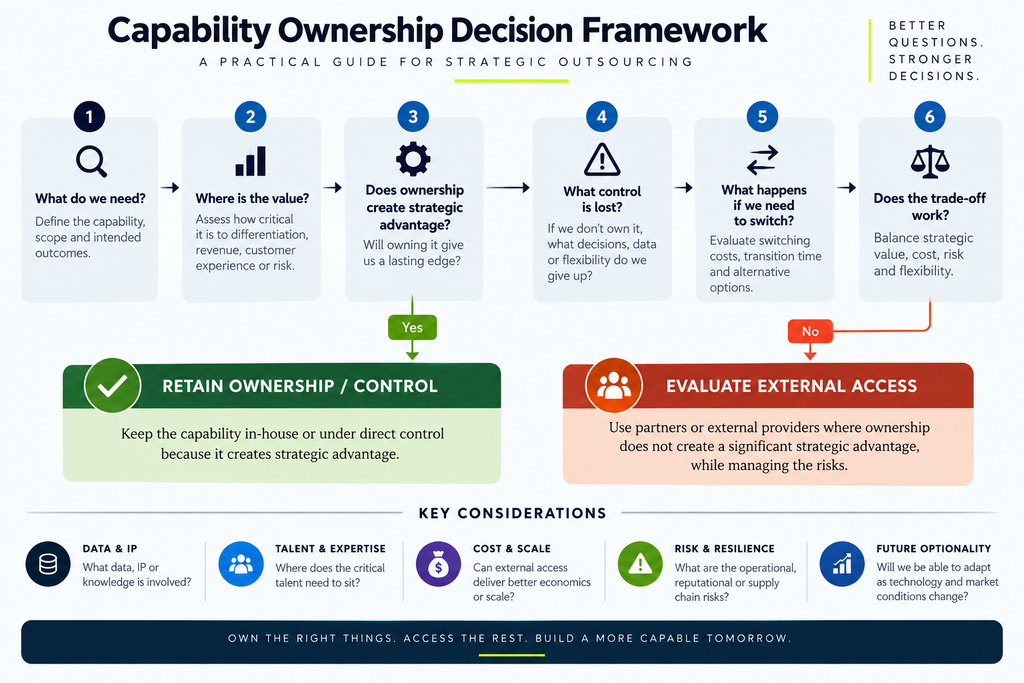
The question is not simply whether an activity should be inside or outside the company. It is whether the ownership structure gives the business the right combination of control, access, flexibility and economics for the role that capability plays in the strategy.
That means two capabilities with similar operational characteristics can legitimately have different ownership structures.
One may need to remain internal because control is strategically important. Another may be suitable for external ownership because the company primarily needs reliable access and specialist expertise.
The architecture should follow the strategic requirement rather than a blanket preference for integration or outsourcing.
The broader lesson
The Porsche–Tata Consultancy Services transaction does not prove that companies should own fewer capabilities.
It illustrates something more useful: a company can decide that it no longer needs to own a capability even when it still needs the capability itself.
But that decision comes with a price.
Giving up ownership normally means giving up some degree of direct control. A long-term contract can protect access, but it cannot remove supplier dependency, switching costs or differences in commercial incentives. Externalization may reduce some ownership burdens while creating other financial and strategic commitments.
The same is true in technology. A company may sensibly rely on external providers for parts of a capability while retaining ownership and control over the data, architecture, knowledge and applications that create strategic value.
The important decision is therefore not whether a capability is important enough to own.
It is whether ownership provides enough strategic advantage to justify the cost and responsibility of keeping it inside the company, and whether the business can accept the control and dependency it takes on if ownership moves outside.
For Porsche, the answer appears to be that continued strategic access to MHP, combined with a broader relationship with Tata Consultancy Services, is more valuable than retaining direct ownership of MHP. Whether that proves to be the right decision will depend on how the relationship performs over time.
That is what makes the transaction worth watching.
It is not simply a story about a company selling a subsidiary.
It is a story about where a company chooses to draw its ownership boundary.
Acquisition Logic Media Perspective
Business architecture is often discussed in terms of what a company should integrate and what it should outsource. The more difficult decisions sit between those two extremes.
A company may need a capability without needing to own the organization that provides it. At the same time, giving up ownership changes the company’s control, dependency and flexibility, so continued access should never be treated as equivalent to continued ownership.
The strategic task is to understand that trade-off before changing the ownership boundary.
For business leaders, the useful question is not simply “Should we own this?”
It is “What does ownership give us, what would we give up by changing it, and which structure leaves the business in the strongest strategic position?”
Frequently Asked Questions
Why did Porsche sell MHP to Tata Consultancy Services?
Porsche said the transaction supports its effort to sharpen its strategic focus and concentrate more strongly on its core business, while continuing its collaboration with MHP and Tata Consultancy Services.
Will Porsche continue working with MHP after the sale?
Yes. Porsche has said that its collaboration with MHP will continue, while Porsche and Tata Consultancy Services are establishing a broader strategic relationship around digital transformation and artificial intelligence.
What does Tata Consultancy Services gain from acquiring MHP?
Tata Consultancy Services gains MHP’s automotive and industrial consulting capabilities, including expertise in areas such as artificial intelligence, SAP, manufacturing digitalisation and connected mobility, which can be combined with Tata Consultancy Services’ wider technology and engineering capabilities.
Does selling a capability mean losing control?
A company normally gives up some degree of direct ownership and control when it sells a capability. Contracts and governance arrangements can preserve certain rights, but they cannot fully reproduce the control that comes with ownership.
Is the Porsche–Tata Consultancy Services transaction simply outsourcing?
The resulting relationship includes strategic outsourcing, but the more fundamental decision concerns whether Porsche needs to own the organization providing the capability. That makes the transaction an ownership and business-architecture decision as well as an outsourcing decision.
When should a company keep a capability in-house?
Ownership is more compelling when a capability provides significant competitive differentiation, involves sensitive intellectual property, requires substantial direct control, contains critical organizational knowledge or would be difficult and expensive to rebuild.
What is the difference between capability ownership and capability access?
Capability ownership concerns who own the organization, assets, people or intellectual property associated with a capability. Capability access concerns whether another company can reliably use that capability. Access can continue after ownership changes, but the level of control, flexibility, dependency and economic exposure can also change.