The Market Sees the Brand. Growth Depends on the Architecture Behind It.
Growth problems are often treated as marketing failures. In reality, many are structural. This insight explores why business architecture determines whether growth becomes predictable, using lessons from Volkswagen, Skoda, and Tata–JLR.
When growth slows, attention usually moves toward the parts of the business that are easiest to see. The product may need to improve. Pricing may be wrong. Positioning may have weakened. Marketing may not be generating enough demand, sales may not be converting it, or distribution may not provide enough reach. Any of these can be the problem.
But the place where a growth problem becomes visible is not necessarily where it begins. A company can struggle to respond to a market because decisions are made too far away from it. It can carry unnecessary cost because similar capabilities are duplicated across separate entities. Demand can exist while distribution remains too limited to capture it, and a strong brand can promise an experience that the supply chain, service network, or operating model cannot consistently deliver.
The market sees the consequence. The constraint may sit much deeper inside the business.
The evolution of Volkswagen Group’s operations in India, considered alongside Tata Motors’ relationship with Jaguar Land Rover, offers a useful way to examine this business architecture strategy problem. The two groups did not arrive at the same structural answer. Volkswagen Group brought previously separate parts of its Indian operations together, while Tata Motors acquired JLR but preserved it as a distinct global automotive business and brand system. One case points toward integration. The other demonstrates the value of separation.
The more useful question, therefore, is not whether businesses should centralize or decentralize. It is whether the architecture of the business fits the constraint it is trying to solve.
Executive Summary
Market Delivery Architecture is the integrated system through which a business transforms ownership, governance, operating models, capabilities, manufacturing, logistics, distribution, brand, and customer experience into value delivered to the market.
This Insight argues that sustainable growth depends less on isolated marketing activity than on how well these interconnected layers align with the constraint currently limiting business performance.
Through the contrasting examples of Volkswagen Group India and Tata Motors–Jaguar Land Rover, it introduces Architecture–Constraint Fit as a strategic framework for diagnosing why growth stalls before deciding how to restore it.
Table of Contents
- Why Business Growth Stalls: When a Market Problem Begins Inside the Business
- Integration Behind the Brand
- The Customer Sees the Outcome of a System
- Tata Motors and JLR: A Different Constraint, a Different Architecture
- Localization Does Not Require the Brand to Become Local
- Distribution Is Not Merely the Final Step
- When the Brand Promise Has to Travel Through the Business
- Centralize What Creates Leverage. Preserve What Creates Differentiation.
- Market Delivery Architecture
- Architecture–Constraint Fit
- Growth Problems Do Not Respect Organizational Boundaries
- The Better Question Is Not "Should We Centralize?"
- The Market Sees the Outcome
Why Business Growth Stalls: When a Market Problem Begins Inside the Business
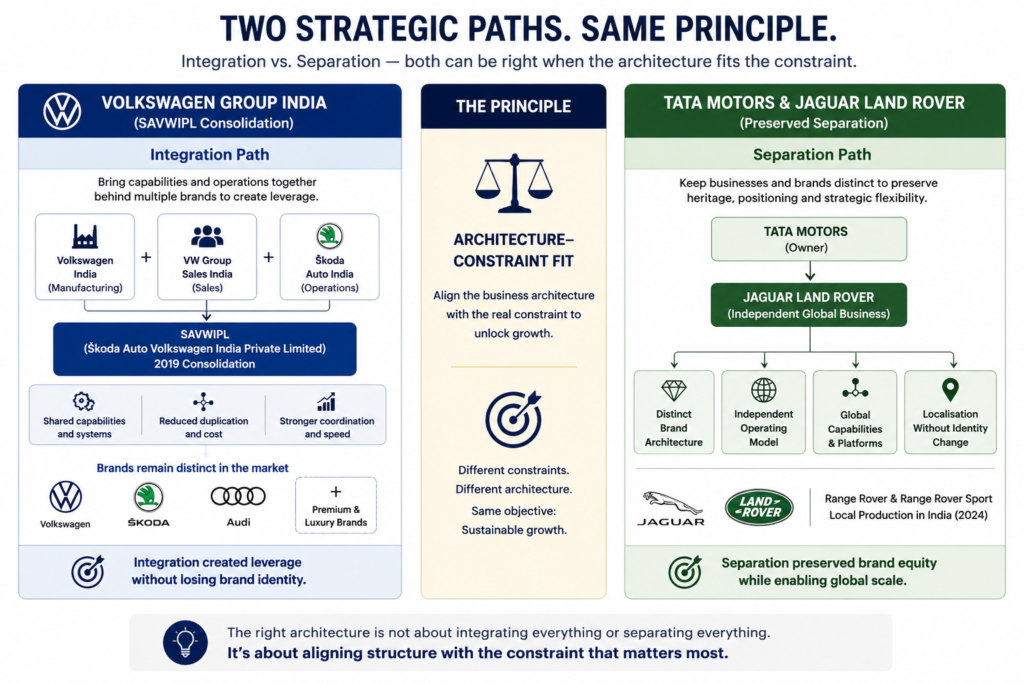
For years, Volkswagen Group’s passenger-car operations in India were divided across separate corporate entities. Volkswagen India managed manufacturing, Volkswagen Group Sales India handled sales activities for several Group brands, and Skoda Auto India operated separately. The brands belonged to the same broader automotive group, but important parts of the Indian operating system remained divided.
That structure eventually changed. Under the INDIA 2.0 program, Skoda assumed greater responsibility for Volkswagen Group’s strategy and model campaign in India, and in 2019, three Indian entities were consolidated into Skoda Auto Volkswagen India Private Limited, or SAVWIPL.
The consolidation did not require the brands to become indistinguishable. Volkswagen remained Volkswagen. Skoda remained Skoda. The Group’s premium and luxury marques continued to occupy their own positions in the market. What changed was the system behind them. More of the Group’s Indian operations could sit within a common structure while the customer-facing brands retained distinct identities, dealer networks, and experiences.
This is an important distinction because businesses often treat integration as if it must be visible to the customer. It does not. The customer does not need to see a shared capability for the company to benefit from it.
Integration Behind the Brand
A customer may experience a company through a product, a showroom, a website, or a service interaction. The organization required to produce that experience is considerably more complex. In the automotive industry, a vehicle can depend on global ownership, local governance, product development, engineering, common platforms, supplier networks, manufacturing plants, logistics systems, parts distribution, dealers, and service infrastructure. These layers belong to the same value-delivery system, but they do not have to be organized in the same way.
Volkswagen Group’s Indian operations illustrate the distinction well. SAVWIPL could provide a more integrated operating structure behind multiple brands while those brands remained differentiated in the market. The same logic appears in the product architecture. Under INDIA 2.0, the Group developed the India-focused MQB-A0-IN platform under Skoda’s leadership, and the Skoda Kushaq, Volkswagen Taigun, Skoda Slavia, and Volkswagen Virtus could share underlying architecture without becoming the same product or carrying the same brand meaning.
The customer sees differentiation. The company captures leverage underneath it.
That leads to a broader principle: operational integration does not require market-facing uniformity. Engineering, procurement, technology, administration, supply chains, and logistics may create more value when shared, while positioning, retail environments, distribution models, and customer experiences may create more value when they remain distinct. The strategic question is not simply what can be combined. It is where integration creates leverage, and where separation preserves value.
The Customer Sees the Outcome of a System
The importance of this distinction becomes clearer beyond the product itself. Consider logistics. A customer rarely thinks about regional parts distribution when buying a vehicle, but if a required part takes weeks to arrive, an internal logistics problem becomes a service problem. Repeated often enough, the service problem becomes a brand problem.
Distribution works in a similar way. A company may have a strong product and genuine customer demand but still struggle to grow if it cannot reach enough buyers, support dealers economically, provide adequate service coverage, or maintain the experience its positioning requires.
The path from company capability to customer value is therefore not a single step. Ownership shapes governance. Governance influences decisions. Decisions shape operating structures and capabilities, which affect manufacturing, supply, and logistics. Distribution determines how the offering reaches the market. Brand shapes expectations, and customer experience determines whether those expectations are fulfilled.
A constraint anywhere in this system can eventually appear as a market problem. Weak logistics can appear as poor service. Limited distribution can appear as weak demand. Slow decision-making can appear as slow innovation, and a cost structure designed for one market can appear as a pricing problem in another. Fragmented operations can appear as inconsistent execution.
The visible symptom may be several layers removed from its cause. This is exactly why a growth diagnosis has to look past the symptom before prescribing a fix.
Tata Motors and JLR: A Different Constraint, a Different Architecture
Tata Motors’ relationship with Jaguar Land Rover provides a useful counterpoint because the structural logic is different. Tata Motors acquired Jaguar and Land Rover in 2008, but ownership changing did not mean the brands were absorbed into Tata’s customer-facing passenger-vehicle identity. Range Rover did not become a Tata SUV. Jaguar did not become a Tata luxury sub-brand. JLR remained a distinct global automotive business, with its own brand system and market meaning.
This is not the same architecture as SAVWIPL, and that is precisely why the comparison is useful. Volkswagen Group consolidated previously separate Indian operations where greater integration could create leverage. Tata Motors did not need to collapse JLR into the Tata passenger-vehicle identity to benefit from owning the business. Different circumstances produced different structural choices.
The lesson is not that integration is better than separation, or that separation is better than integration. The value of either depends on what the business is trying to achieve and what it risks weakening in the process.
Localization Does Not Require the Brand to Become Local
The distinction becomes even clearer when manufacturing enters the picture. In 2024, local production of Range Rover and Range Rover Sport was announced in India. The manufacturing footprint could move closer to the Indian market without changing what customers believed they were buying. The ownership was Indian, manufacturing could take place in India, and the brand could still retain the heritage, positioning, and customer meaning associated with Range Rover.
Ownership, manufacturing, operating structure, and brand identity are therefore separate design decisions. A company can own globally, design in one market, manufacture in another, source from several regions, and distribute locally while maintaining a brand identity associated with somewhere else entirely.
This matters because modern businesses are rarely as organizationally simple as the brands through which customers encounter them. They are systems of capabilities, and the strategic task is deciding where those capabilities should sit, which should be shared, and which should remain deliberately distinct.
Distribution Is Not Merely the Final Step
Distribution is often treated as something that happens after the strategy has been decided. That understates its role. Where a product is sold, who represents it, how accessible it is, and what surrounds the transaction all influence the value customers perceive.
A Volkswagen showroom does not need to create the same experience as a Lamborghini showroom because the two brands happen to sit within the same broader group. A Tata Motors dealership does not need to become a Range Rover showroom because Tata ultimately owns JLR. Shared ownership does not imply shared distribution, and shared operations do not necessarily imply identical routes to market. Different brands may require different geographic coverage, showroom economics, dealer capabilities, service models, inventory strategies, customer relationships, and levels of exclusivity.
Distribution therefore does more than make a product available. It also helps communicate what kind of product the customer is buying.
Distribution is not only how a company reaches the market. It is part of how the market experiences the company.
This is why excessive integration can be as damaging as excessive fragmentation. Combining activities may create efficiency, but if the combination weakens positioning, damages exclusivity, or produces an inconsistent customer experience, the efficiency comes at the expense of value.
When the Brand Promise Has to Travel Through the Business
A company can create a sophisticated strategy and still lose control of the experience at the final point of contact. The advertising may promise premium while the showroom feels ordinary. The product may be sophisticated while the service experience is frustrating. The company may have strong engineering while a customer waits weeks for a spare part.
Inside the organization, these may belong to different functions. The customer does not experience them that way. The customer experiences the combined result. Marketing performance, dealer performance, logistics performance, and service performance eventually meet in the same place: the customer’s judgment of the business.
The farther a brand promise has to travel through operational and distribution layers before reaching the customer, the more that promise depends on the quality of the entire system behind it. A brand, in that sense, is not created by communication alone. Operations continuously validate or contradict it.
Centralize What Creates Leverage. Preserve What Creates Differentiation.
The Volkswagen–Skoda and Tata–JLR cases suggest a useful principle for any centralization vs. decentralization strategy decision: centralize what creates leverage, and preserve what creates differentiation.
Shared engineering may create leverage. A common platform may create leverage. Consolidated procurement, integrated logistics, or shared infrastructure may create leverage. A distinct brand may create differentiation. A specialized distribution experience may create differentiation, and so may a particular design philosophy or luxury retail environment.
But even this principle has limits. Centralization creates its own costs. Integration introduces coordination, shared systems can reduce flexibility, and standardization can weaken local responsiveness. The reverse is also true. Preserving too much independence can produce duplication, internal competition, and unnecessary complexity. The objective is therefore neither maximum integration nor maximum autonomy. It is the right architecture for the constraint.
The 2017 discussions between Tata Motors, Volkswagen Group, and Skoda are instructive here. The companies explored a potential strategic collaboration around joint development and other areas of cooperation, and the discussions were later discontinued. The broader point is not that collaboration was a mistake. It is that theoretical synergy does not make integration automatically desirable. Synergy has to justify the complexity required to create it. Integration is not free.
Market Delivery Architecture
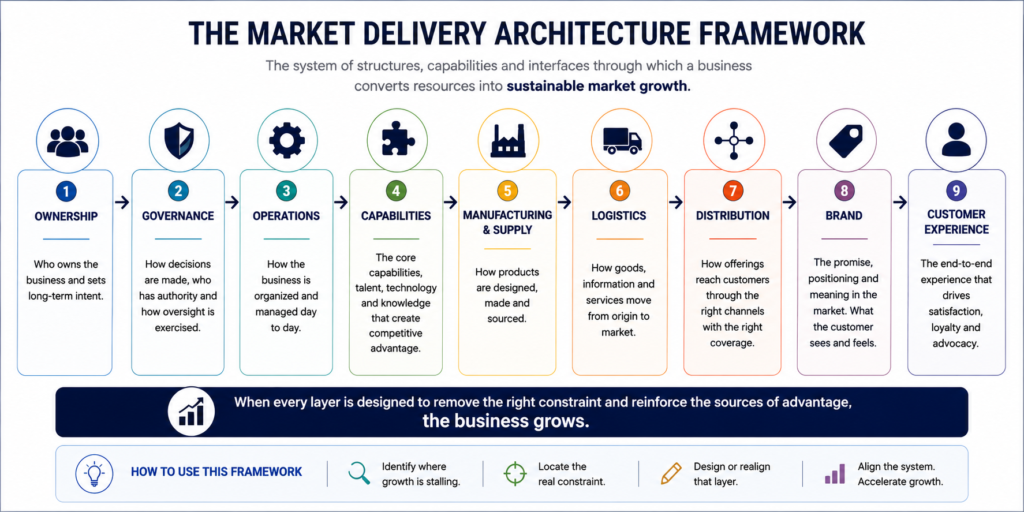
These cases point toward a broader way of thinking about how businesses reach and serve markets. At Acquisition Logic Media, we call this Market Delivery Architecture. It is the system of structures, capabilities, decisions, and interfaces through which a business converts its resources into value delivered to a market.
It includes several connected layers. Ownership Architecture asks who owns the assets, capital, and economic interest. Governance Architecture asks where important decisions are made and who is accountable for them. Operating Architecture determines which activities are integrated and which remain separate, while Capability Architecture determines where engineering, technology, talent, data, and specialist expertise sit. Manufacturing and Supply Architecture covers where and how the product is created, sourced, and supported, and Logistics Architecture covers how materials, finished products, and after-sales requirements move through the system. Distribution Architecture determines how the offering commercially reaches the customer. Brand Architecture determines what identities and meanings the market encounters. Experience Architecture determines what the customer actually experiences across discovery, purchase, delivery, ownership, and service.
These layers are connected, but they do not need to mirror one another. One company can own several businesses. One operating company can support several brands. Several brands can share a platform, a shared platform can feed different distribution systems, and different distribution systems can create different customer experiences. The mistake is assuming that because two activities belong to the same company, they should necessarily be organized in the same way.
Architecture–Constraint Fit
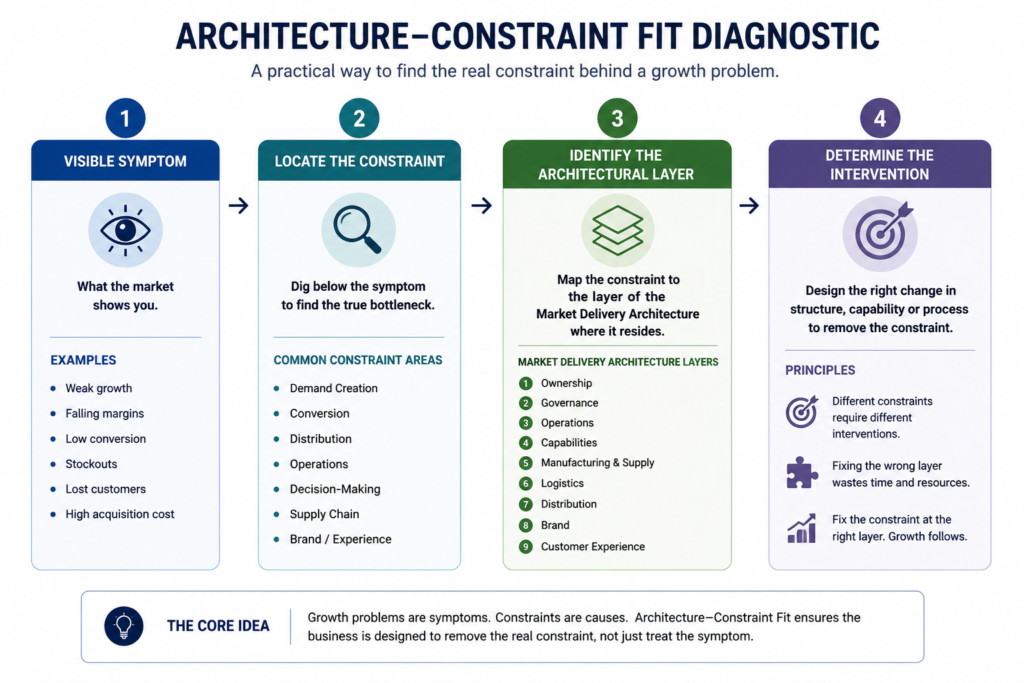
The more important question is whether this architecture fits the problem the business is trying to solve. We call this Architecture–Constraint Fit: the degree to which the way a business is organized supports the removal of the constraint currently limiting its growth.
Consider two companies facing the same visible problem. Growth in a market is too slow. For one company, awareness may genuinely be the constraint, and more effective acquisition could help. For another, demand may already exist, and the actual constraint may be slow decisions, insufficient distribution, weak service capacity, poor unit economics, fragmented operations, import dependence, limited supply, or an inability to adapt the offering to the market.
The symptom can look similar. The intervention should not be. If the constraint is demand, improve demand generation. If the constraint is conversion, improve conversion. If the constraint is distribution, redesign market access. If the constraint is logistics, repair the flow of products or parts. If the constraint is organizational, another marketing campaign may do very little.
The right intervention depends on where the constraint actually sits. This is the entire premise behind diagnosing before prescribing.
Growth Problems Do Not Respect Organizational Boundaries
This has an important implication for leaders: a growth problem may not belong neatly to the growth team. Marketing may discover it, sales may experience it, and customers may complain about it, but the cause may sit somewhere else entirely. A campaign can generate demand that operations cannot fulfill. A sales team can win customers that distribution cannot serve. A strong brand can create expectations that the service network cannot meet, and a local market team can identify an opportunity that the organization is too slow to act on.
The growth system extends beyond the growth department. This does not mean every business needs a corporate restructuring, or that every operational problem should be reframed as a growth problem. It means that when growth repeatedly fails to respond to surface-level interventions, leaders should examine whether the constraint sits deeper in the system.
The Better Question Is Not “Should We Centralize?”
Centralization and decentralization are often discussed as competing management philosophies, but that framing is rarely useful enough. The better questions are more specific:
- Where is fragmentation creating friction, and where is integration creating unnecessary complexity?
- Which capabilities become more valuable when shared, and which sources of differentiation become weaker when standardized?
- Where are decisions being made too far from the market, and where is local autonomy creating duplication without creating additional value?
- Where does the customer need consistency, and where does the customer value distinction?
- Which operational constraint is being misdiagnosed as a marketing problem?
These questions move the conversation away from organizational fashion. Centralization is not inherently sophisticated, and decentralization is not inherently agile. Integration is not inherently efficient, and autonomy is not inherently innovative. Each is a design choice, and its value depends on the constraint.
The Market Sees the Outcome
Customers rarely see the architecture behind a business. They do not see reporting lines, procurement systems, legal entities, or internal decision rights, and they do not see the negotiations between suppliers, factories, distributors, and dealers. They see the outcome. The product is available, or it is not. The price makes sense, or it does not. The experience is consistent, the service works, and the brand promise is delivered. Or one of those things quietly breaks down.
That is why growth friction can be deceptive. It often becomes visible at the edge of the business while originating much further inside it.
Volkswagen Group’s India restructuring and Tata Motors’ relationship with JLR do not offer a universal organizational formula. They offer something more useful: different constraints require different architectures. One situation may require consolidation, another may require autonomy. One capability may benefit from global scale, while another needs to sit closer to the local market. One layer may need to become common, while another needs to remain deliberately distinct.
The objective is not to build the most integrated company, and it is not to build the most decentralized one. It is to build an architecture capable of delivering the strategy.
Before asking how to generate more growth, it may be worth asking whether the business is architected to deliver it.
Because the market sees the brand. But growth depends on the system behind it.