When Commerce Becomes Discovery: How Quick Commerce Is Changing FMCG Growth
Quick commerce is changing more than where FMCG products are purchased. It is changing how they are discovered, considered and captured. This Insight examines the shift from traditional distribution to a more connected growth system, where demand, discovery, availability, economics and platform dependency increasingly shape how brands grow.
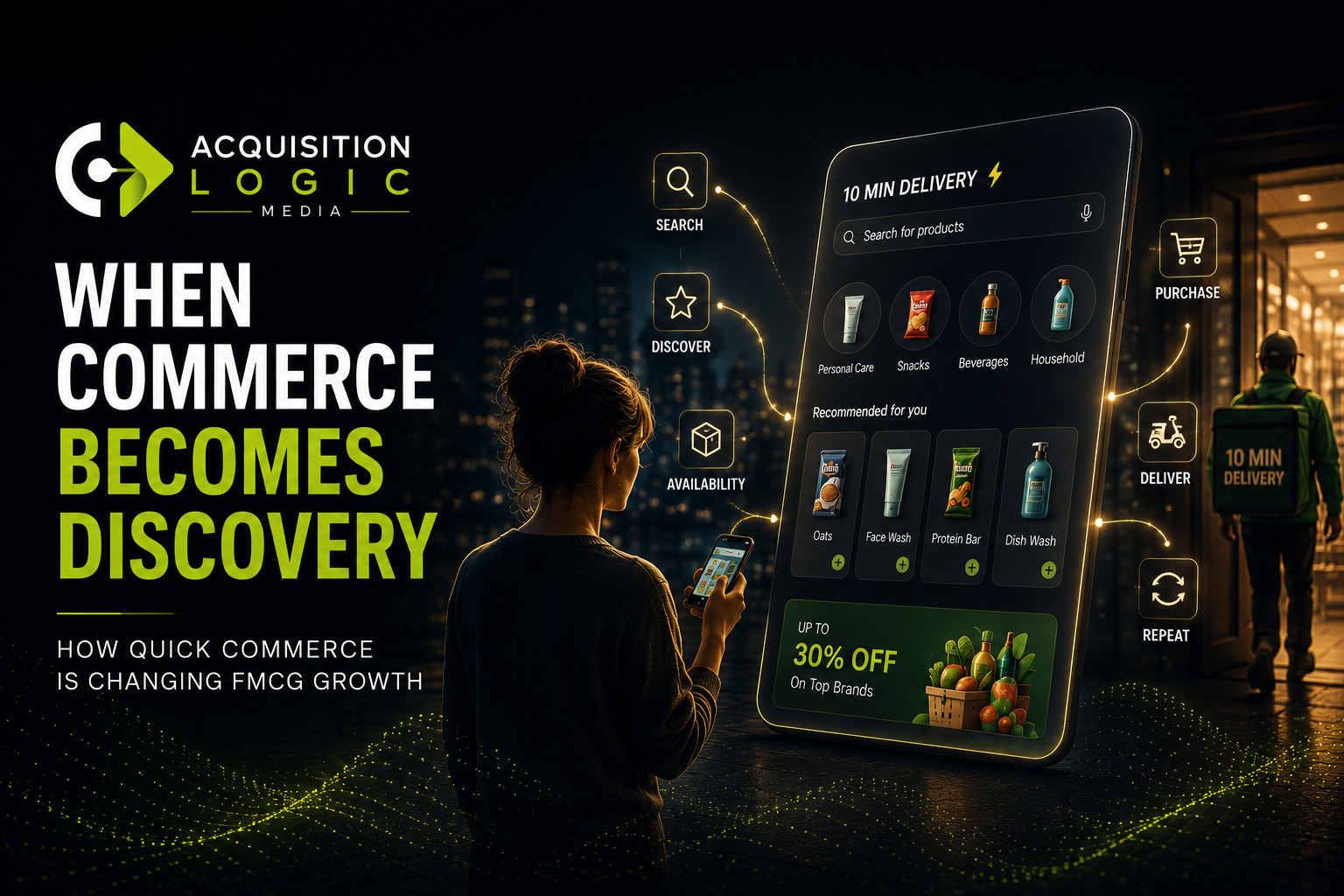
Table of Contents
- The changing architecture of FMCG growth in India
- Quick Commerce and FMCG Growth Are Becoming Increasingly Connected
- Is quick commerce becoming a new search environment for FMCG?
- FMCG discovery is moving closer to commerce
- Demand is not the same as demand capture
- Discovery is not necessarily organic discovery
- Quick commerce growth does not automatically mean incremental FMCG growth
- The consumer's need state matters more than the category label
- The platform's incentives are not identical to the brand's
- Platform access is not the same as customer ownership
- Growth can create dependency
- Growth is not the same as economic quality
- Growth constraints do not stay in one place
- The Next-Generation FMCG Growth Architecture
- What this changes for FMCG brands
- The larger shift is bigger than quick commerce
- What the next generation of FMCG growth will require
The changing architecture of FMCG growth in India
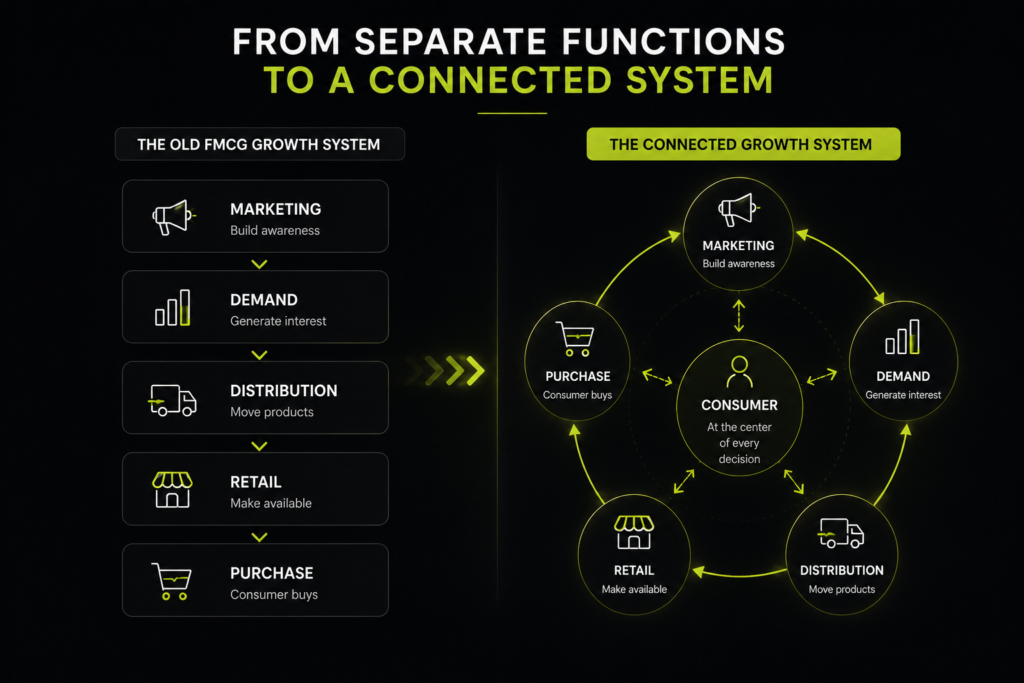
For years, the logic of FMCG growth was relatively straightforward. Brands created awareness, built preference and pushed products through increasingly broad distribution networks. Retailers made those products available, consumers chose among them, and sales data eventually came back to the brand. Marketing, distribution and commerce were closely connected, but they still operated as distinct parts of the growth system.
That separation is becoming harder to maintain. The rise of quick commerce is one of the clearest signals of this change, particularly in India’s major urban markets. What began primarily as a proposition built around convenience and speed has become an increasingly important environment for FMCG sales, but the more interesting development is not simply that products can reach consumers within minutes. It is that the same commercial environment can increasingly influence what consumers discover, what they consider, what is available to them and what they ultimately purchase.
That raises a much larger question for FMCG businesses:
what happens when commerce itself becomes part of discovery?
Quick Commerce and FMCG Growth Are Becoming Increasingly Connected
The scale of the shift is no longer marginal. NielsenIQ reported that e-commerce accounted for 18% of FMCG sales in India’s top eight metros during October to December 2025, with quick commerce contributing more than three-quarters of e-commerce FMCG sales in that measurement. Economic Times reporting has also shown quick commerce becoming a substantial part of online FMCG sales for several major companies, demonstrating that the channel is moving well beyond its original perception as a niche convenience format.
Those numbers are significant, but they can also lead to the wrong conclusion if they are interpreted too quickly. A larger share of FMCG sales through quick commerce does not automatically mean that the same proportion of demand was newly created by the channel. Industry executives have also described quick commerce as increasingly taking sales from ecommerce, modern trade and kirana stores, which means some of the growth represents a change in where consumers purchase rather than an equivalent increase in total consumption.
The same transaction can therefore represent very different things for a brand. It might be genuinely incremental demand, a purchase that happened earlier because the product was immediately available, a larger basket, a switch from a competing brand, or simply a purchase that moved from another retail channel. Those outcomes may all appear as quick-commerce sales, but their strategic value and economic consequences are very different.
That is why the more useful question is not simply, “How much are we selling through quick commerce?” The more important question is, “What is quick commerce changing about how consumers discover, choose and buy our products?”
Is quick commerce becoming a new search environment for FMCG?
The comparison between quick commerce and search engines is understandable. A consumer can open a quick-commerce application, enter a product or category, see brands and alternatives, compare prices and pack sizes, respond to recommendations or promotions, and complete the purchase within the same environment. The distance between expressing an intention and completing a transaction can therefore be remarkably short.
However, describing quick commerce as the “new search engine” for FMCG is too simplistic. A conventional search engine primarily helps someone find information, websites or answers, whereas a commerce platform operates much closer to the transaction and can influence what happens after a consumer expresses an intention to buy. The consumer may arrive knowing the category they need without knowing the brand they will choose, which gives the platform an opportunity to influence consideration as well as fulfilment.
Consider a shopper searching for toothpaste who has no fixed brand preference. The consumer may encounter several brands, different pack sizes, promotional offers and recommendations before deciding what to purchase. A similar process can happen when someone searches for protein snacks, skincare or household products and discovers an unfamiliar brand that was not part of the original consideration set.
The platform is therefore doing more than helping the consumer locate something they already know. It can participate in the process through which products become visible, comparable and ultimately selectable, which makes the relationship between discovery and commerce increasingly important.
FMCG discovery is moving closer to commerce
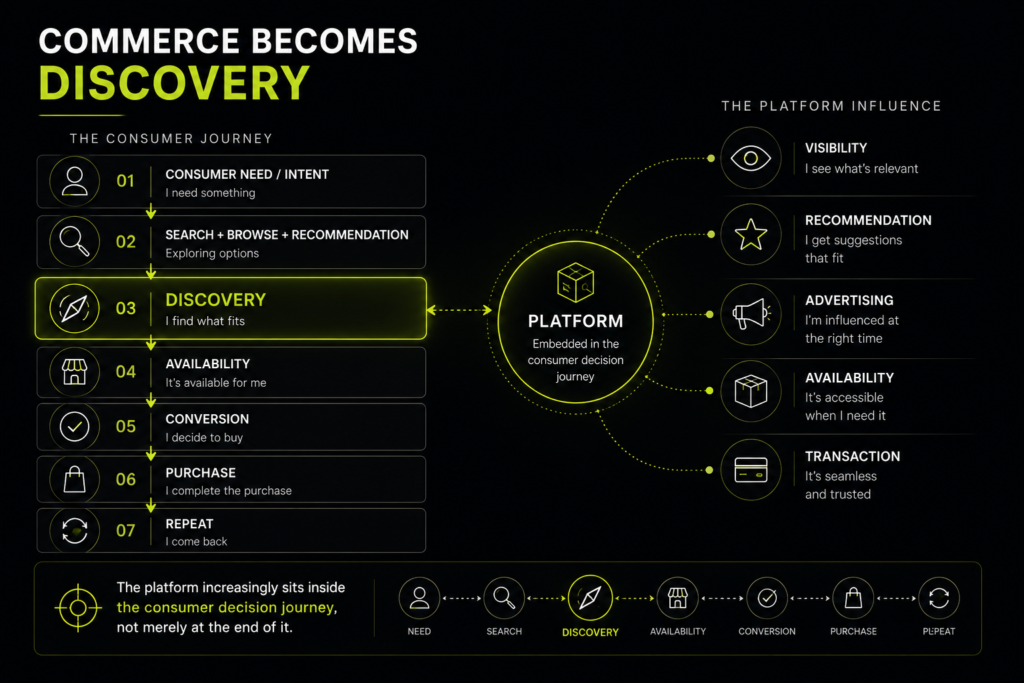
Traditionally, discovery happened somewhere upstream of the transaction. Advertising created awareness, content developed interest, search captured intent, distribution made the product available and the consumer eventually reached the shelf or checkout where the purchase decision was completed. Digital commerce has already compressed some of these stages, while quick commerce pushes the compression further by bringing discovery, recommendation, availability and transaction into a much more tightly connected environment.
This changes the role of the channel. A consumer does not necessarily arrive with a fully formed brand decision. They may arrive with a need, a category or even a momentary problem, and the commerce environment can influence which options become visible and which products are easiest to purchase.
For FMCG brands, that means the competitive battle is no longer limited to creating demand before the consumer reaches the retailer. It increasingly includes the ability to capture demand at the point where the consumer is deciding what to buy. The difference may appear subtle, but strategically it is significant because the company that creates demand and the company that captures that demand are not always the same.
Demand is not the same as demand capture
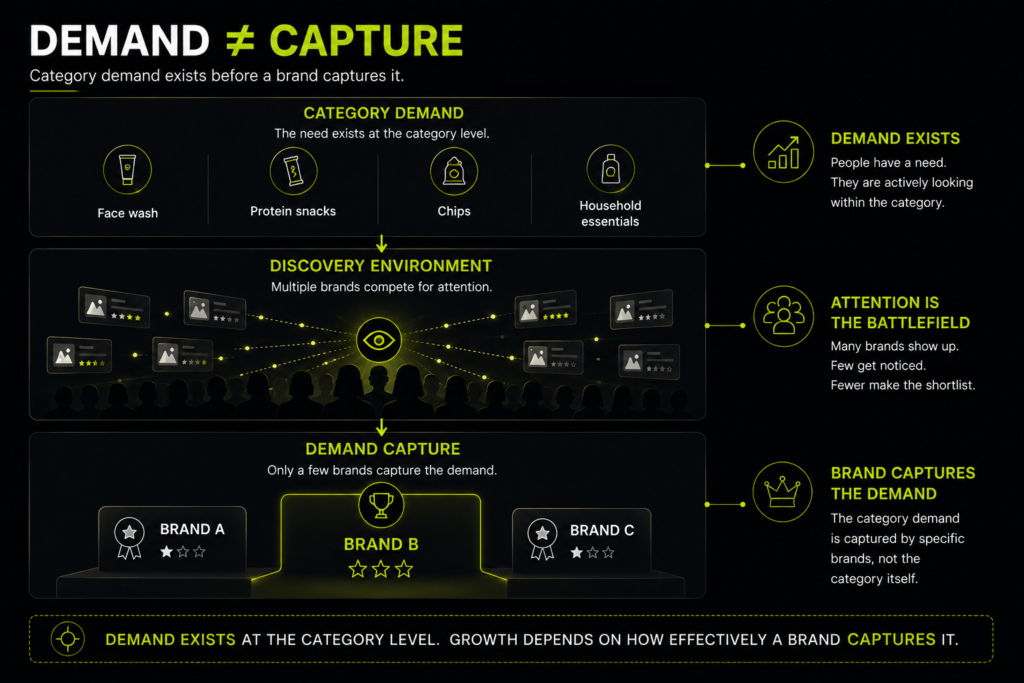
A consumer can have strong category demand without having a preference for a particular brand. Someone searching for face wash is expressing demand for a category, but that demand does not belong to any one brand yet. Someone looking for protein snacks may know the problem they want to solve without knowing which product will solve it, while someone searching for chips may simply be looking for something suitable for the moment.
The brand still has to capture that intent, and this is why Demand ≠ Capture is becoming an increasingly useful way to think about FMCG growth. A company can invest heavily in creating awareness and generating category interest but still lose the purchase at the point where consumers compare and choose. Another brand can capture existing category demand without having created that demand itself.
Quick commerce makes this distinction particularly visible because the consumer can move from category intent to product selection within the same environment.
The question therefore changes from “How much demand does the category have?” to “How effectively can the brand capture the demand that already exists?”
That is a fundamentally different growth problem, and it becomes more important as commerce platforms gain greater influence over what consumers encounter at the point of purchase.
Discovery is not necessarily organic discovery
There is another complication that FMCG brands cannot ignore. When a product appears prominently inside a commerce platform, it is tempting to assume that the platform’s algorithm simply determined that the product was relevant. Increasingly, that assumption is incomplete because commerce platforms are also building advertising businesses around the visibility they provide.
Blinkit’s current advertising platform, for example, offers sponsored placements across search, category and cart environments, along with recommendation and other advertising formats. Its platform also provides brands with ways to compare paid and organic performance and measure outcomes such as search lift and conversions.
This creates an important distinction between being discoverable and paying to become more visible. The two can coexist, but they represent different sources of competitive advantage and different economic models. A product that is discovered organically because of strong relevance, availability, ratings or purchase velocity is benefiting from a different mechanism than a product that requires continual paid visibility to appear in important consumer moments.
The commerce platform is therefore becoming more than the place where the transaction takes place. It is increasingly becoming a retail media environment in which brands compete not only for sales but also for visibility.
That creates a new strategic question for FMCG leaders: when discovery itself becomes monetized, what happens to the economics of customer acquisition?
Quick commerce growth does not automatically mean incremental FMCG growth
This is where the excitement around quick commerce needs some discipline. Imagine a consumer who normally buys shampoo from a supermarket but begins ordering it through a quick-commerce platform. The platform’s sales increase, the brand’s quick-commerce sales increase and the consumer benefits from greater convenience, but the underlying business may not have created an entirely new purchase. The transaction may simply have moved from one channel to another.
Now consider a different consumer who discovers a new snack brand while browsing, adds it to an existing basket and eventually becomes a repeat customer. That outcome could represent something much closer to incremental demand. Both transactions appear as quick-commerce sales, but their strategic value is different.
This is why FMCG companies should distinguish between channel growth and business growth. A channel can grow rapidly while part of that growth is transferred from another channel, and the business may therefore overestimate the amount of genuinely new demand it has created.
The more useful analysis asks whether quick commerce is creating new consumption, increasing purchase frequency, accelerating replenishment, winning customers from competitors, expanding geographic access or simply changing where an existing purchase takes place. Without that distinction, sales growth can look more incremental than it actually is.
The consumer’s need state matters more than the category label
It is also easy to make the wrong assumptions about which FMCG products belong on quick commerce. A product’s suitability is not determined only by whether it is considered a staple, premium product or impulse purchase. The underlying purchase mechanics often matter much more, including frequency, urgency, replenishment, substitutability, consideration and basket behaviour.
A consumer urgently replacing a household essential is behaving differently from someone browsing for a new premium snack. Someone replenishing a familiar product has a different intent from someone discovering an unfamiliar brand, and a high-frequency product can behave very differently from one purchased only occasionally.
This is why even categories that initially appear poorly suited to quick commerce can behave differently when their actual demand mechanics are understood. Instead of asking whether a particular FMCG category “fits” quick commerce, brands should ask what consumer need state the channel is actually solving for the product and whether that need state creates a meaningful commercial advantage.
That shift from category labels to consumer mechanics can reveal opportunities that a simple channel classification would miss.
The platform’s incentives are not identical to the brand’s
There is another structural change that deserves more attention. The brand wants profitable growth, repeat purchase, customer loyalty and stronger control over its relationship with the consumer, while the commerce platform has its own objectives around order growth, basket value, frequency, advertising revenue, contribution and inventory productivity.
Those objectives overlap, but they are not identical. The platform can increasingly occupy several roles at once, acting as a distribution partner, discovery environment, advertising supplier and, in some categories, a competitor through private labels or other owned products.
This creates an information asymmetry as well. A platform can potentially observe patterns across thousands of brands and millions of transactions, including what consumers search for, what they compare, what they purchase, what they reorder and which products perform in particular locations. A single brand sees only a fraction of that market and may not have access to the same depth of category intelligence.
This raises a deeper question than whether a brand is simply “present” on quick commerce: who is learning more from the transaction, the brand or the platform? The answer can influence how valuable the channel is over the long term, particularly when the platform becomes an increasingly important part of the brand’s growth model.
Platform access is not the same as customer ownership
A brand can own its product, trademark and packaging while still having limited control over the environment through which the consumer discovers and purchases that product. The platform may influence ranking, recommendations, advertising, availability and the commercial conditions under which the transaction occurs, while the brand may receive sales information without possessing the same depth of customer and category intelligence.
This does not make platform distribution inherently negative. For many brands, quick commerce can provide valuable access to consumers, improve availability and create opportunities for trial that would otherwise take considerably longer to build through traditional distribution.
The strategic mistake is assuming that access to a platform is equivalent to owning the customer relationship. It is not. For a growing FMCG brand, that distinction becomes increasingly important when a single platform begins to represent a substantial share of demand because the value created by the channel can simultaneously increase the company’s exposure to it.
Growth can create dependency
A successful channel can gradually become a dependency. At first, the relationship may be straightforward: a brand wants access to consumers, so it lists its products on the platform, while the platform provides reach, availability and transaction infrastructure.
As sales grow, however, the platform becomes more important to the business. The brand can become increasingly exposed to changes in ranking, advertising costs, commissions, assortment rules, promotions, inventory expectations and consumer behaviour. The channel that helped accelerate growth can therefore become one of the systems that the growth model depends upon.
This does not mean that brands should avoid concentration or attempt to distribute every sale evenly across every channel. It means that concentration should be understood as a strategic variable rather than ignored because the sales numbers look attractive.
The relevant question is not simply whether a platform is delivering growth. It is whether the business is becoming structurally dependent on that platform to sustain the growth, and whether the economics and strategic control remain attractive as that dependency increases.
Growth is not the same as economic quality
Another constraint can disappear from view when revenue growth becomes the headline metric. Swiggy’s Instamart provides a useful illustration of why scale and economic quality need to be considered separately.
In its FY2026 results, Swiggy reported that Instamart’s GOV grew 68.8% year over year to ₹7,881 crore, while its contribution margin improved 65 basis points quarter over quarter to -1.8%. The monthly contribution margin had improved further to -1.1% in March 2026, although the business still reported a significant adjusted EBITDA loss for the quarter.
The lesson is not that quick commerce is economically broken. In fact, the direction of the contribution margin shows that the economics are improving. The more important point is that rapid transaction growth and improving unit economics are separate dimensions of performance, and both need to be understood before growth can be considered economically attractive.
The same principle applies to FMCG brands. A business can have strong demand, strong discovery and strong sales while still struggling with margins after promotions, platform costs, advertising, fulfilment and the other costs required to sustain that growth.
Revenue tells us that the system is moving, but economics tell us whether the movement is creating value. That distinction becomes increasingly important as brands compete for visibility inside commerce environments where advertising and promotion can become part of the cost of remaining discoverable.
Growth constraints do not stay in one place
This is where the conventional growth funnel becomes less useful. A company may begin with a demand problem, only to find that availability becomes the constraint once demand improves. When availability is fixed, conversion may become the bottleneck, and once conversion improves, the business may discover that repeat is weak or that the economics of acquiring those customers do not work.
Solving one problem can therefore reveal another. We call this Growth Constraint Migration, because the constraint moves as the business changes and the system responds to previous interventions.
This matters because many growth strategies assume that an organization can identify its problem once, solve it and then scale. In reality, growth changes the system itself. The intervention that solves today’s constraint can create the conditions under which tomorrow’s constraint becomes visible, which means diagnosis cannot be treated as a one-time exercise.
For FMCG businesses operating across increasingly interconnected channels, the ability to identify the current constraint may therefore become more valuable than simply adding another channel or increasing another marketing input.
The Next-Generation FMCG Growth Architecture
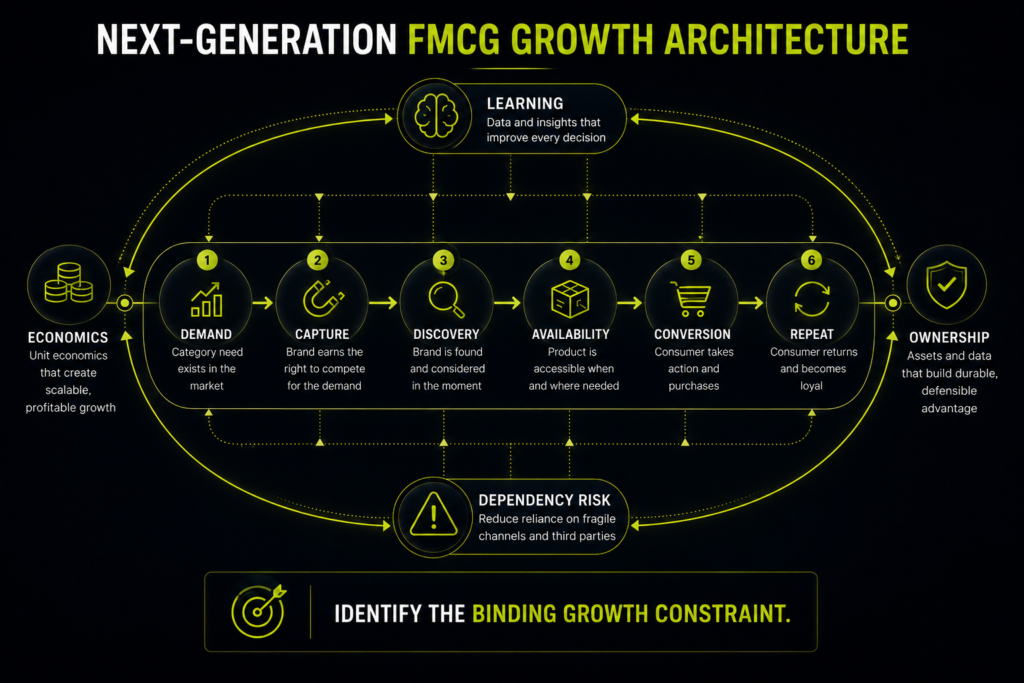
This is why we believe FMCG growth needs to be viewed as an architecture rather than only as a marketing funnel. At the front of the system is Demand, which asks whether the market actually wants the proposition. Demand alone, however, is not enough. The business must be able to Capture that demand, make the product discoverable, maintain Availability, convert consideration into purchase and ultimately create Repeat behaviour.
Around that growth flow sit several questions that determine whether the growth can become durable. Learning asks whether the organization can turn market behaviour into better decisions, while Economics asks whether the growth creates economic value. Ownership asks how much of the customer relationship, commercial intelligence and critical growth infrastructure the business controls, while Dependency Risk asks how exposed the growth model is to systems outside the company’s control.
The architecture therefore looks less like a straight funnel and more like a connected system:
Demand → Capture → Discovery → Availability → Conversion → Repeat
with Learning, Economics, Ownership and Dependency Risk shaping the quality and durability of the growth that emerges from it.
The purpose is not to give every business another scorecard to complete. The purpose is to help identify the binding constraint that is preventing the system from converting its available demand into stronger and more durable growth.
What this changes for FMCG brands
If commerce is becoming part of discovery, being present on a quick-commerce platform cannot be treated simply as a distribution decision. A brand first needs to understand what role the platform is actually playing in its growth model and whether that role is changing as the business scales.
Is the platform creating new demand or mainly capturing existing demand? Are consumers discovering the brand organically, through recommendations or through paid placements? Is availability preventing sales that marketing has already created? Are promotions generating genuine preference or temporary trial? Is repeat strong enough to justify the acquisition cost?
The economic questions matter just as much. What contribution remains after discounts, advertising and platform-related costs, and does the brand become more profitable as it scales or simply more dependent on volume? The ownership question matters too, because a company can achieve impressive sales through a platform without necessarily building equivalent customer knowledge or control over the relationship.
These questions lead to a much better strategic conversation than simply asking whether the brand should “go onto quick commerce.” Acquisition Logic Media help a business understand what the channel is actually doing for growth and what the business is giving up in exchange for that growth.
The larger shift is bigger than quick commerce
Quick commerce may be one of the clearest places to observe this change, but the underlying idea extends beyond ten-minute delivery. Recommendation systems, retail media, marketplaces and increasingly AI-assisted shopping are all moving parts of the consumer decision process closer to the point of transaction.
As these systems evolve, the boundary between marketing, distribution and commerce becomes less clear. The consumer may no longer experience these as separate stages, even though businesses continue to manage them through different teams, budgets and performance metrics.
That is why the question we began with, whether quick commerce is becoming the new search engine for FMCG, is ultimately too narrow. The more important shift is that commerce itself is becoming part of discovery, and that changes the strategic environment in which FMCG brands compete.
When the same environment can influence discovery, availability, visibility, transaction and repeat purchase, the growth problem becomes broader than generating demand. It becomes a question of how effectively the entire system can turn demand into durable and economically sound growth.
What the next generation of FMCG growth will require
The companies best positioned for this environment will not necessarily be those with the largest advertising budgets or the greatest number of channels. They will be the companies capable of understanding where growth is actually constrained, responding to that constraint and recognizing when the constraint has moved somewhere else.
That requires a different way of looking at growth. Companies need to understand the difference between demand and demand capture, distinguish organic discovery from paid visibility, measure incremental growth rather than celebrating channel sales alone, and watch economics as closely as revenue. They also need to understand the difference between platform access and customer ownership, particularly when an increasingly large share of demand flows through a small number of commerce environments.
Most importantly, growth needs to be treated as a connected system rather than as a collection of isolated marketing activities. Demand enters the system, the business attempts to capture it, consumers discover and evaluate alternatives, availability determines whether intent can become a transaction, conversion determines which product wins and repeat determines whether the transaction becomes behaviour. Economics determine whether the growth creates value, while ownership and dependency determine how durable that growth can be.
The constraint can move at any point in that system. A business that solves demand today may face availability tomorrow, economics later and dependency after that. The ability to recognize those changes is therefore becoming an important part of growth strategy itself.
That is why the next generation of FMCG growth may not be defined simply by who can create more demand. It may be defined by who can understand how demand moves through the system and identify what is preventing that demand from becoming durable growth.
Quick commerce did not create this change. It simply makes the change easier to see.
Acquisition Logic Media’s view is that the strategic opportunity is no longer to ask which channel will create the next wave of FMCG growth. It is to understand the architecture through which discovery becomes demand, demand becomes revenue and revenue becomes durable growth.